
Bird Control, Safety Netting & Edge Protection
Our Story and Mission
Leven Group Ltd specialises in safety net rigging and fall arrest systems, along with edge protection and anti bird netting systems. We provide a safe and reliable service to the construction industry, offering affordable protection throughout the UK. We work on a wide range of sites from small builds to sites over 100,000 sqm plus.
Our Experienced Team
Our skilled team is committed to understanding your unique protection requirements. With extensive industry experience, we provide expert advice and installations that ensure safety and peace of mind across all environments.
Introduction to Safety Netting
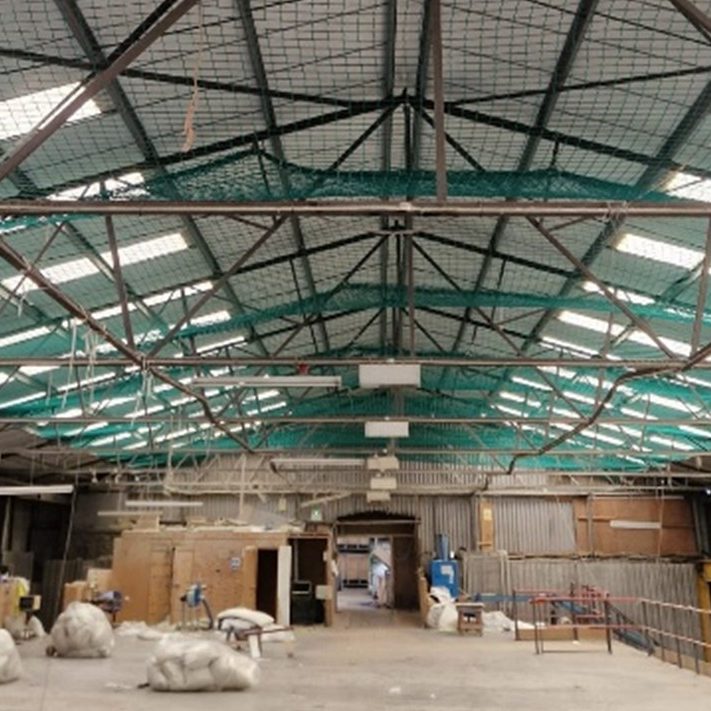
Here at Leven Group we believe that safety netting offers the best protection for workers above while also allowing freedom of movement below for other trades.
We install all aspects of safety netting for existing roofs and new build roofs. We also provide vertical netting, debris netting and sacrificial netting. We only use Safety Nets which conform to BS EN 1263 – 1:2014. Our Safety Net Systems are installed to BS EN 1363 – 2:2014 and BS 8411:2007 Code of Practice, so you can be assured that our safety net systems can perform to a high standard when needed.
Our netting complies with all the relevant health and safety legislation.
Debris netting is an optimum solution for the protection of site personnel, road and pedestrian traffic, and adjacent properties from the risk of falling tools and debris. Debris netting can also act as an effective wind, vision or shade barrier for the protection of operatives whilst on site. Our debris net systems provide a fine mesh overlay to installed safety net systems. Debris nets can be attached to edge protection systems. Sacrificial netting or Roof over netting is used as a last resort when fixing a new roof over an existing roof.
Introduction to Bird Netting
Bird Netting is the most effective form of bird proofing and should always be the first consideration when choosing a method of pigeon proofing.
Bird nets can be used to cover small areas such as a single ledge or eave, they can also be used in larger areas such as an entire roof or parts of roofs over plant. As netting often covers many perching areas it is often the most cost-effective form of bird proofing.
Polyethylene knotted nets can withstand a wide range of environmental conditions and as long as they have been installed in the correct fashion and have not been damaged by other trades should have a life expectancy of 10 years. Care must be taken to ensure that the lines of the net and running in a uniform pattern and once this is achieved it often blends into the structures it is covering.
Anti perch bird spikes are also a very common and effective form of proofing. They are commonly installed on ledges, sills, pipes, parapets aerials, leading edges of roofs etc, to prevent birds from landing and settling. Bird spikes are pre-assembled making them a quick and a relatively inexpensive form of bird control.
Bird spikes can be installed in a number of ways including silicone (ledges, pipes, flat surfaces), cable ties (to pipes, railings) or gutter clips which fix to the underside of the base and simply click onto the leading edge of the gutter / hopper head thus not effecting the flow of water. A series of holes in the base of the strip allows for the bird spikes to be nailed or screwed into wood or concrete.
The principle of the net system is that a tensioned wire rope is fitted around the perimeter of the area to be covered. The wire rope is held in place by a combination of corner fixings and intermediate fixings. The wire rope frame is tensioned using a series of barrel strainers constructing the frame onto which the net is attached using hog rings.
What the fitters don’t tell you when they install your solar panels is that they are creating a perfect, warm, sheltered area, nice and high up that pigeons in particular love. At Leven Group we are specialists in solar panel bird proofing measures, and we cover all of England and Wales for this service, we are able to provide a full, one-stop service for solar panel pigeon control. The service includes shoo-ing away adult birds, removal of any redundant nesting material and a biocide treatment underneath the panels to try and deal with any insects associated with the abandoned nests.
For the proofing itself we use a robust galvanised steel pigeon guard that comes in solid sheets rather than in mesh rolls. We cut it to size using industrial cutters to fit around the outer edges of the panels and ride the highs and lows of your roof tiles, to create a neat, long-lasting, robust and very good-looking shield that stops pigeons getting under your panels long term. There is no drilling involved in the fitting; that would invalidate your warranty. The panels of mesh are attached around the outer edges using a variety of UVA stable clamps and ties
Introduction to Edge Protection
We provide Edge Protection attached to all forms of steelwork for new buildings with sloped or flat roofs. We also erect Edge Protection built from the floor to suit all heights. We ensure all our Edge Protection systems complies with the current British & European standards for working at height.
Scaffold edge protection consists of either, aluminium beams or triple aluminium tube, in accordance with SG27 NASC health and safety guidance. Scaff tags and hand over certification will be completed after each job.
We offer a range of temporary edge protection systems to provide complete safety for site personnel working at height. Our Edge Protection systems are lightweight, designed to meet your requirements and quick to install.
All temporary edge protection system installations are carried out by CISRS trained (Levels 1 & 2) staff members who are also IPAF trained.
Our temporary edge protection systems tested to Class A, B and C of the European Standard BS EN 13374:2013.
- Class A: Provides protection to flat surfaces and slopes up to 10o. It provides resistance to static loads and is based on the requirements to support a person leaning against, walking beside and possibly stumbling against the edge protection.
- Class B: Provides protection to flat surfaces and slopes generally up to 30o, and to even steeper slopes with short slope lengths. It provides resistance to both static and low dynamic loads and is based on the requirements to support a person leaning against, walking beside, and possibly stumbling against, and sliding down a sloping surface towards the edge protection.
- Class C: Provides protection to steeply sloping surfaces generally up to 45o, and up to 60o for 5m slopes. It provides resistance to high dynamic loads only and is based on the requirements to contain a person sliding down a steeply sloping surface.